Flexible Enclosures in Industry 4.0: Protection and Efficiency for Automated Equipment
Flexible Enclosures for Industry 4.0 Industrial Automation
Discover how flexible technical barriers and industrial curtains help protect equipment, reduce exposure to industrial contaminants, and improve the efficiency of automated production cells.
Industry 4.0 industrial automation has transformed the way companies manufacture, monitor, and control their processes. Industrial robots, intelligent sensors, connected systems, and high-precision equipment now operate together, increasing productivity while creating a greater need for controlled operating environments.
However, as technology becomes more sophisticated, certain components may also become more sensitive to external factors present in industrial environments. Dust, metal particles, welding spatter, localized heat, and continuous movement create challenges for equipment preservation and production continuity.
In this context, flexible industrial enclosures provide an alternative for creating adaptable technical barriers that accommodate production requirements without unnecessarily restricting access to equipment.
- Reduce equipment exposure to industrial particles and debris.
- Adapt technical barriers to the movements and layouts of automated production cells.
- Facilitate access for inspections and maintenance.
- Contribute to workplace organization and industrial safety.
Technical overview: flexible industrial enclosures are an alternative custom industrial protection solution for automated equipment and manufacturing processes. CIKALA develops customized solutions that consider environmental conditions, operational requirements, and the technical demands of each application.
The Challenge of Equipment Safety and Preservation in Industry 4.0 Automation
Unlike stationary machinery, robotic cells and advanced automation systems involve continuous movement, articulated components, sensors, wiring, and communication devices that must operate in a coordinated manner.
The presence of abrasive particles, dust, and industrial debris can increase cleaning and maintenance requirements. In certain applications, these contaminants may also accelerate component wear and interfere with the operation of sensitive systems.
For this reason, selecting an appropriate industrial protection solution requires considering not only physical separation but also the dynamic characteristics of the manufacturing process.
Key Requirements in Automated Industrial Environments
- Mobility: accommodate equipment operation involving movement, articulation, and displacement.
- Technical accessibility: allow planned inspections, adjustments, and maintenance operations.
- Appropriate resistance: use materials compatible with the thermal, mechanical, and chemical conditions of the application.
- Operational integration: avoid unnecessary interference with sensors, wiring, and other devices.
- Layout adaptability: account for limited spaces, existing machinery, and installation constraints.
Rigid or improvised solutions may complicate technical interventions, occupy valuable space, and create areas where industrial debris accumulates. Properly designed flexible systems, on the other hand, offer greater adaptability to different industrial configurations.
Important: flexible industrial enclosures must be selected according to the actual risks and operating conditions of each application. Barriers manufactured from flexible materials do not automatically replace safety devices, interlocking systems, or other protective measures required by risk assessments and applicable safety standards.
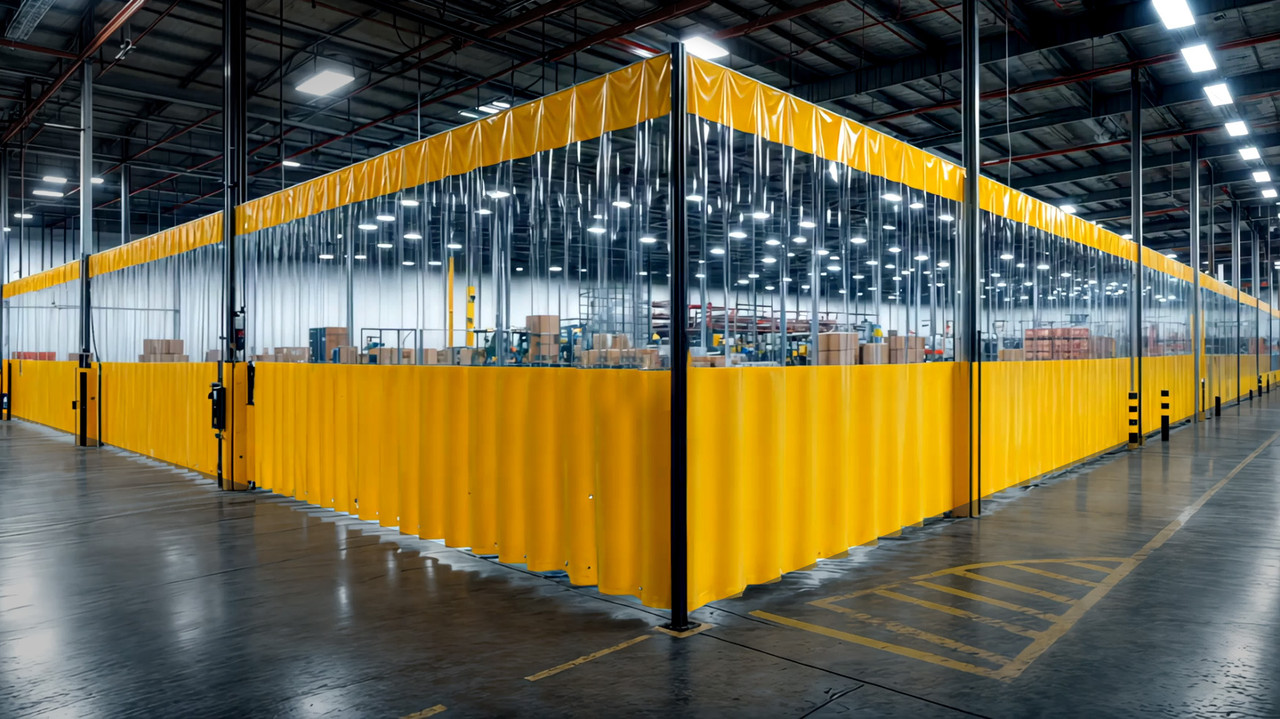
What Are Flexible Industrial Enclosures?
Flexible industrial enclosures consist of barriers manufactured from technical materials designed to define, separate, or partially or completely isolate specific areas within a manufacturing process.
Unlike exclusively rigid structures, these solutions may incorporate industrial curtains, technical fabrics, removable modules, and other flexible components adapted to installation requirements.
Their purpose is to create functional separation between equipment, processes, and surrounding environments, helping control exposure to certain industrial contaminants and operating conditions.
Main Types of Flexible Industrial Enclosure Solutions
- Technical industrial curtains: used to separate manufacturing areas, define process boundaries, and control exposure to specific industrial contaminants.
- Removable protective covers: designed for specific components or assemblies that require adaptable protection.
- Modular flexible barriers: allow industrial partitions to be configured according to available space and operational requirements.
- Custom industrial enclosures: engineered according to dimensions, mounting points, access requirements, and the specific characteristics of each industrial application.
How Do Flexible Enclosures Work in Robotic Cells?
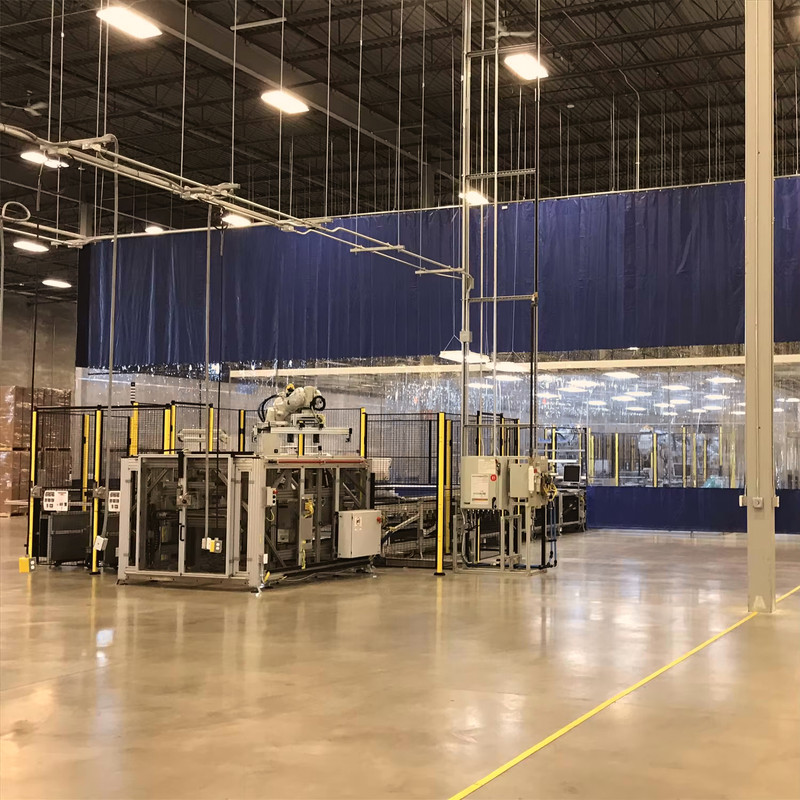
In an automated production cell, flexible enclosures can be installed around specific equipment or at strategic points within the manufacturing process, creating a physical barrier between the production area and the surrounding environment.
Depending on the design, this configuration can help reduce particle dispersion, limit component exposure to industrial debris, and improve workspace organization.
Barrier geometry, material selection, and mounting systems must account for robotic movements, personnel circulation areas, and maintenance procedures.
Technical advantage: a custom flexible enclosure solution allows dimensions, materials, and installation requirements to be evaluated according to the specific operating conditions of each machine or manufacturing process.
Benefits of Flexible Industrial Enclosures for Industry 4.0
Implementing flexible barriers designed for specific applications can provide significant operational advantages for companies using automated manufacturing systems.
Beyond separating industrial environments, these solutions can contribute to equipment preservation, improved process organization, and more efficient maintenance activities.
Reduced Exposure to Particles
Properly installed barriers help limit the dispersion of dust, debris, and particles generated by certain industrial processes.
Improved Component Preservation
Reducing exposure to external contaminants can help preserve sensors, mechanical assemblies, and sensitive electronic components.
Easier Maintenance Access
Removable configurations or strategically designed access points can facilitate inspections and technical maintenance procedures.
Flexible Installation Options
Solutions can be developed for different dimensions, industrial layouts, and the specific requirements of individual manufacturing processes.
Main Applications of Flexible Industrial Enclosures
Flexible industrial enclosures can be used across different manufacturing sectors, particularly in processes that require a balance between functional isolation, equipment accessibility, and environmental adaptability.
- Robotic manufacturing cells: separation of production areas and installation of barriers adapted to automated equipment characteristics.
- Automated production lines: organization of manufacturing areas containing integrated equipment and systems.
- Particle-generating processes: reduction of debris dispersion from specific industrial operations.
- Welding operations: application of specialized technical materials selected according to operating temperatures, welding spatter, and associated risks.
- Equipment requiring frequent maintenance: use of removable barriers or strategically designed access points.
- Space-constrained industrial environments: adaptation of barriers to existing structures and installation limitations.
How to Choose the Right Material for a Flexible Industrial Enclosure
Material selection depends on actual operating conditions. No single flexible material is suitable for every industrial process.
Before selecting a solution, it is important to evaluate:
- Operating temperature and the possibility of contact with heated surfaces.
- Presence of abrasive particles, spatter, or chemical agents.
- Dimensions of the area requiring isolation.
- Frequency of opening, removal, and maintenance activities.
- Requirements for transparency or process visibility.
- Equipment movement and available mounting points.
Safety consideration: applications involving intense heat, welding operations, mechanical hazards, or chemical exposure require appropriate materials and technical specifications. Selection must account for operating conditions and applicable technical and safety requirements.
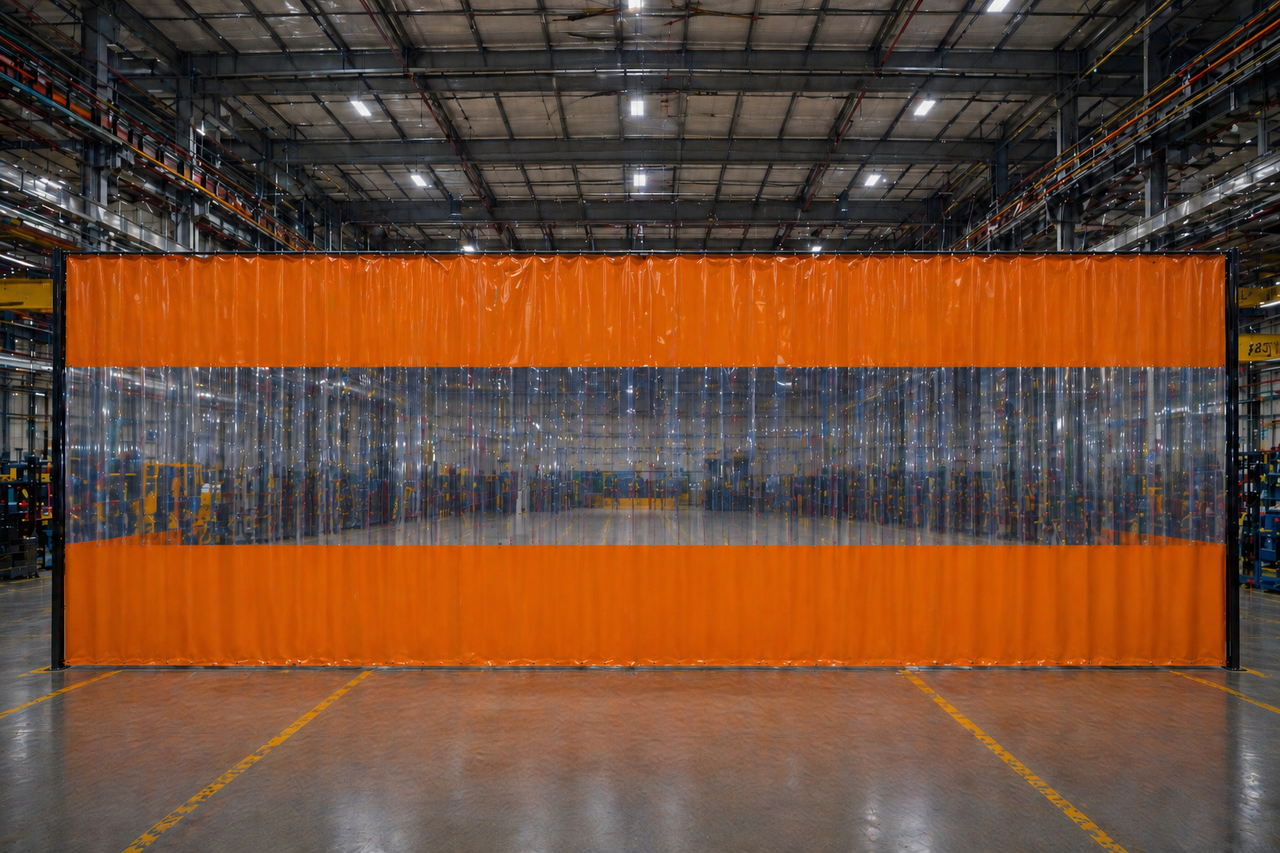
Flexible Industrial Enclosures and Operational Continuity
In Industry 4.0 manufacturing, production efficiency depends on the integration of machinery, sensors, control systems, and maintenance teams.
When industrial components remain exposed to aggressive environmental conditions, additional cleaning, inspection, and component replacement activities may become necessary.
Properly designed flexible industrial enclosures can form part of a preventive protection strategy aimed at reducing this exposure and improving equipment preservation conditions.
The Importance of Custom Technical Design
Every industrial environment has unique characteristics. A robotic welding cell, for example, has different requirements from those of an automated assembly line.
Therefore, implementing flexible barriers requires evaluating the manufacturing process, material characteristics, equipment movements, and applicable safety requirements.
For specialized applications, developing a custom-engineered solution makes it possible to assess adaptation options, mounting points, and access requirements before manufacturing the final product.
Recommendation: to evaluate the feasibility of a flexible industrial enclosure, gather information about equipment dimensions, facility layout, contaminants present in the process, machinery movements, and critical operating conditions.
Industrial Solutions from CIKALA
CIKALA develops technical solutions for industrial applications requiring flexible materials, customized dimensions, and careful consideration of each manufacturing environment's specific characteristics.
For flexible industrial enclosure projects, material selection and system configuration must consider factors such as installation geometry, operating temperature, exposure to external contaminants, and operational and maintenance requirements.
By analyzing application conditions, it becomes possible to identify alternatives for integrating technical barriers with existing equipment and industrial structures.
When Should You Request a Custom Industrial Enclosure?
- When the dimensions of the area do not match standard solutions.
- When equipment movements or articulated components must be considered.
- When the environment presents specific thermal or mechanical conditions.
- When opening or removal points are required for maintenance access.
- When installation must accommodate an existing industrial layout.
Next step: send photographs of your facility, approximate dimensions, information about your manufacturing process, and details of the main operational challenges so the CIKALA team can evaluate the possibilities for a customized industrial solution.
Conclusion: Why Invest in Flexible Enclosures for Industrial Automation?
Flexible enclosures for Industry 4.0 industrial automation provide an alternative for companies seeking to combine advanced technology, efficient production organization, and equipment preservation.
By using appropriately selected technical barriers, manufacturers can reduce exposure to specific industrial contaminants, simplify maintenance planning, and adapt installations to the characteristics of automated production systems.
However, the effectiveness of these solutions depends on proper material selection, accurate sizing, and a thorough evaluation of the risks involved.
Working with a company specializing in flexible industrial solutions can therefore help transform operational requirements into technically appropriate applications.
CIKALA provides alternatives for manufacturers seeking customized industrial solutions, including applications requiring flexible barriers, technical industrial curtains, and adaptations to specific manufacturing environments.
Need Flexible Industrial Enclosures for Your Manufacturing Facility?
Explore industrial solutions in the CIKALA online store or request an assessment for a customized industrial application.
If your company operates robotic cells, automated production lines, or equipment with specialized isolation requirements, send photographs, dimensions, and details about your manufacturing process.
For specialized technical and industrial applications, contact our team through WhatsApp to discuss the possibilities of a custom-engineered industrial enclosure designed for your operational requirements.
Frequently Asked Questions About Flexible Industrial Enclosures
1. What is a flexible industrial enclosure?
A flexible industrial enclosure is a solution that uses barriers, curtains, or flexible technical materials to separate or isolate industrial areas and equipment. Its configuration can be adapted to the dimensions, layout, and operational requirements of each manufacturing process.
2. Can flexible industrial enclosures be used in robotic cells?
Yes. Depending on application conditions, flexible barriers can be integrated into robotic cells to define operational areas and reduce exposure to certain industrial contaminants. The design must account for equipment movements and applicable safety requirements.
3. What are the main benefits of flexible industrial enclosures?
Key benefits include reduced particle dispersion, improved organization of manufacturing areas, planned maintenance access, and the ability to adapt barriers to different industrial configurations.
4. How can I request a custom flexible industrial enclosure?
The recommended approach is to gather photographs of the facility, approximate dimensions, information about the equipment, and details of the manufacturing process. With this information, the technical team at CIKALA can evaluate the application's requirements. To discuss a custom industrial enclosure project directly, contact the team through WhatsApp.
Find CIKALA on Google Maps
View our location on Google Maps and discover our contact channels for industrial solutions and customized engineering projects.
Discover CIKALA — Corporate Video
Learn more about our company, industrial solutions, and expertise in developing products and applications designed to meet a wide range of industrial requirements.

