Industrial robotic arm protection: greater efficiency and durability in automation
Industrial robotic armwith custom protection
How to protect robots, sensors, and critical components against contamination, wear, and unplanned downtime.
The industrial robotic arm increases productivity, precision, and repeatability. But in harsh environments, automation only delivers consistent results when the equipment operates with technical protection compatible with the process.
Abrasive dust, paint mist, welding spatter, metal particles, oil, and chemical residues can reach joints, sensors, hoses, connections, and critical components. Over time, this increases maintenance, reduces service life, and raises the risk of downtime.
- Preservation of components exposed to industrial contamination.
- Greater stability for automated processes.
- Reduction of corrective interventions and unplanned downtime.
- Development according to geometry, movement, and working environment.
CIKALA develops industrial custom-made solutions for robotic protection, automation, and technical applications in harsh environments.
Why protect the robotic arm?
The industrial robot can operate in welding, painting, handling, palletizing, cutting, assembly, and inspection. In many of these applications, the issue is not only the robot’s movement, but also the surrounding environment.
Without an adequate technical barrier, contaminants come into direct contact with sensitive areas of the equipment. The result appears in operational failures, loss of precision, premature wear, and more frequent maintenance.
Points that should be evaluated
- Type of contamination present in the process.
- Robot movement range and geometry.
- Temperature, abrasion, and chemical contact.
- Need for maintenance access.
- Most suitable technical material for the application.
In practice, the right protection helps preserve the asset and maintain productivity without relying on improvised solutions.
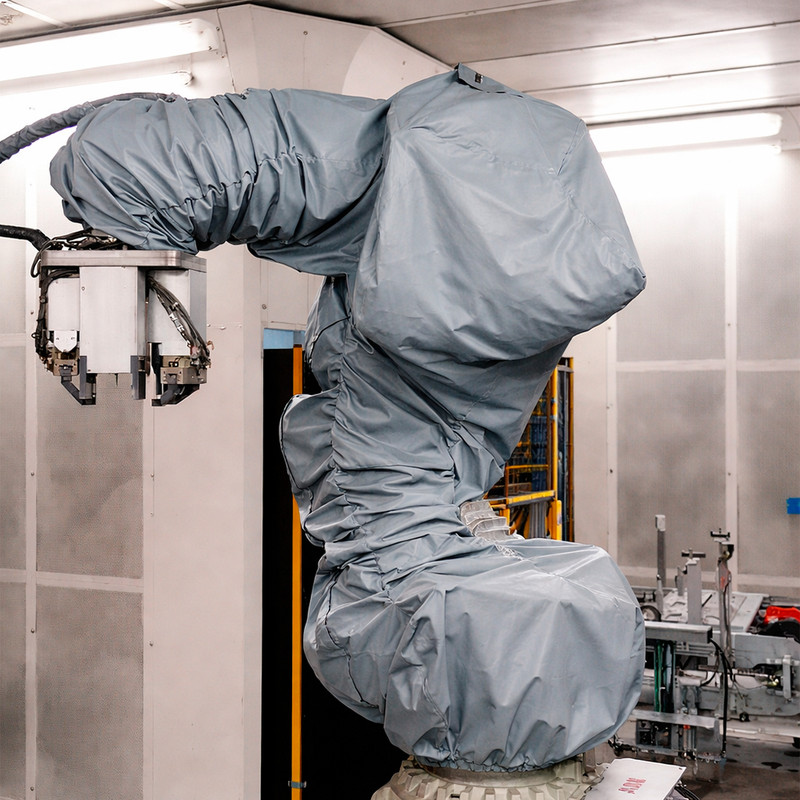
Robotic protection must be technical
A cover or barrier for an industrial robot cannot be treated as a generic part. It must follow the equipment’s movements without limiting operation, creating excessive friction, or compromising maintenance.
That is why the development must consider the process, available space, contaminants present, and the expected performance of the robotic cell.
Common applications
- Protection against paint mist and chemical residues.
- Protection against dust, chips, and abrasive particles.
- Protection against welding spatter and industrial dirt.
- Protection for hoses, sensors, connections, and joints.
Each project requires its own analysis. The safest solution is to size the protection according to the real operating environment.

Benefits for industrial operations
When protection is developed with the right criteria, the robotic arm operates more reliably. The company reduces exposure to contaminants and improves the predictability of the production routine.
Helps protect critical areas against dirt, abrasion, and process residues.
Reduces risks associated with contamination and corrective maintenance.
Helps preserve robots, sensors, hoses, and connections.
A solution developed according to movement, layout, and environmental aggressiveness.

Conclusion
Industrial automation does not depend only on the robot. It also depends on the right protection to maintain precision, productivity, and service life in harsh environments.
With a technical custom-made solution, the operation reduces risks, preserves assets, and improves the reliability of the robotic cell.
CIKALA works from technical fabrics to custom manufacturing, developing solutions for different industrial operation needs.
Need to protect robotic arms, machines, or industrial components? Talk to CIKALA and request an evaluation for a custom project.
Frequently asked questions
Why does a robotic arm need protection?
Because contaminants such as dust, paint, oil, chips, spatter, and chemical residues can reach sensitive components and harm operation.
Can protection limit the robot’s movement?
Yes, when it is poorly sized. That is why the design must consider geometry, movement range, fastening points, and material type.
Is it possible to develop a custom-made solution?
Yes. In industrial applications, a custom solution is usually the best option, since each robot and each environment have their own requirements.

