Geomembrane for Ornamental Ponds: Complete Selection Guide
Building an ornamental pond in your garden is a dream for many aquatic landscaping enthusiasts. But to ensure durability, prevent leaks and maintain a safe environment for fish and plants, choosing the right waterproofing system is essential. In this guide, you’ll learn what to evaluate in practice to choose the best waterproof liner for your project and avoid costly mistakes.
The geomembrane for ornamental ponds is a technical solution designed to ensure efficient waterproofing, structural safety and durability in landscaping projects. Made from flexible and resistant materials such as PVC, it prevents leaks, protects the soil and creates a safe environment for fish, aquatic plants and decorative water features. Its flexibility allows it to adapt to different pond shapes, reduces maintenance and increases the project’s service life.
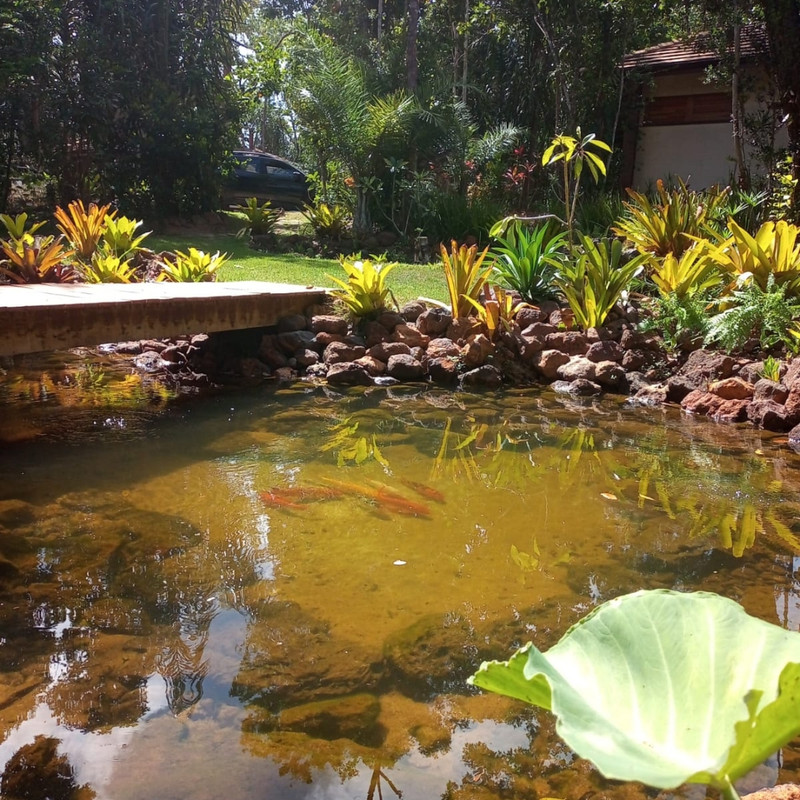
Why use a geomembrane in ornamental ponds
Artificial pond waterproofing with a technical liner provides a continuous barrier against leaks, with faster installation than rigid solutions and excellent performance predictability. When the goal is to create a stable water feature with low maintenance and long service life, geomembrane becomes a logical choice for residential projects and also for common areas in condominiums, hotels and developments.
Typical benefits for ornamental ponds: efficient sealing, adapts to any shape, strong cost-benefit, lower cracking risk compared to rigid structures, and greater durability than common tarps.
Unlike concrete, which can crack over time and requires specialized labor, a flexible liner accommodates small ground movements. Compared to common plastic tarps, a technical liner has controlled composition and thickness, higher mechanical resistance and—when properly specified—better performance under sunlight exposure.
What is a geomembrane for ornamental ponds and how does it work
A geomembrane is a waterproof liner applied to the bottom and sides of the pond, forming a continuous physical barrier between the water and the soil. In practice, it “decouples” the water volume from the natural ground, reducing losses by infiltration and helping keep the pond water level stable.
In an ornamental pond with a geomembrane, performance is directly linked to three factors: material specification (type and thickness), subgrade preparation (removing stones/roots and leveling), and edge finishing (proper anchoring, avoiding leak paths).
Main problems caused by inadequate waterproofing
Before choosing materials, it’s important to understand the classic symptoms of failures in artificial pond waterproofing. They often appear gradually and, when ignored, lead to rework.
- Recurring drop in water level (without evaporation compatible with the climate);
- Persistent moisture around the pond, erosion and unstable edges;
- Turbidity caused by soil and particle wash-in;
- Difficulty achieving biological stability in ponds with fish and plants;
- Frequent maintenance with spot fixes that don’t address the root cause.
Critical point: small leaks rarely “stop on their own.” If waterproofing is not continuous and stable, the tendency is to evolve into larger losses and damage to the surrounding area.
Difference between geomembrane, common tarp, masonry and concrete
A common ornamental pond tarp can be used in temporary situations, but it usually does not have technical control of thickness, dimensional stability or adequate resistance to remain for years in contact with water, thermal variations and soil movement.
Masonry or concrete structures require more complex work, base preparation, proper curing, joints and, often, additional waterproofing systems. Even when well executed, they may develop microcracks over time.
In landscaping projects, a technical waterproof liner stands out by offering:
- High adaptability to organic shapes and curves;
- Faster installation, with less disruption on site;
- Lower maintenance when properly specified and installed;
- High durability outdoors (with UV protection).
Technical tip: regardless of the solution, performance depends on ground preparation, puncture protection (geotextile underlayment) and proper edge detailing.
Types of geomembrane for ornamental ponds
There are different materials used in waterproof liners for reservoirs and ponds. The best choice depends on pond size, the type of aquatic life, the shape (tight curves or straight lines) and the level of sun exposure.
HDPE (High-Density Polyethylene)
HDPE is known for high chemical and mechanical resistance and strong performance under sunlight when properly specified. In general, it is commonly used in reservoirs and can also be used in ornamental ponds, especially in larger projects with less complex geometries. Because it is more “rigid” than PVC, it often requires extra care in curves and finishing details.
PVC
PVC is highly valued in landscaping for its flexibility and ease of conforming to organic shapes. This supports projects with curves, steps and detailed edges, reducing stress points during installation. When the pond requires a refined finish and adaptation to the garden design, a PVC geomembrane for ponds tends to be a very efficient choice.
Solution recommended by CIKALA for most ornamental projects: 1000-micron PVC geomembrane, with an excellent balance between mechanical resistance, flexibility and durability.
How to choose the ideal PVC geomembrane for a pond
Thickness: what to consider in practice
Thickness directly affects mechanical resistance, puncture tolerance and service life. In ornamental ponds, the most common range is from 0.8 mm to 1.0 mm, varying by size and use.
- 0.5 mm: small, shallow decorative ponds with lower mechanical demand.
- 0.8 mm: good balance for residential ponds with plants and small fish.
- 1.0 mm (1000 microns): recommended for medium to large ponds, with greater robustness and durability.
- 1.5 mm or more: applications with higher puncture risk, higher traffic or commercial projects.
Flexibility and shape conformity
In projects with tight curves, steps, shelves and organic edges, flexibility reduces excessive folds and stress concentrations, contributing to a cleaner finish and long-term stability.
UV protection and sun exposure
For an outdoor ornamental pond, specification should consider performance under solar radiation. A UV-resistant geomembrane helps preserve mechanical properties and reduce premature aging.
Compatibility with aquatic life
When the project includes koi, ornamental fish and aquatic plants, the material must be suitable for continuous contact with water. In general, high-quality technical PVC is widely used in ornamental solutions due to its stability and ease of installation.
Material calculation: how to size the geomembrane for your pond
To estimate the required area, a practical formula is:
(Length + 2 x depth + 0.5 m) x (Width + 2 x depth + 0.5 m)
Example: a 3 m x 2 m pond with 0.8 m depth: (3 + 1.6 + 0.5) x (2 + 1.6 + 0.5) = 4.1 x 4.1 = 16.81 m².
In practice, add 10% to 15% for folds, adjustments and edge finishing. If the pond has complex curves, steps or shelves, this allowance becomes even more important.
Pond installation and finishing
Installation: simplified step-by-step
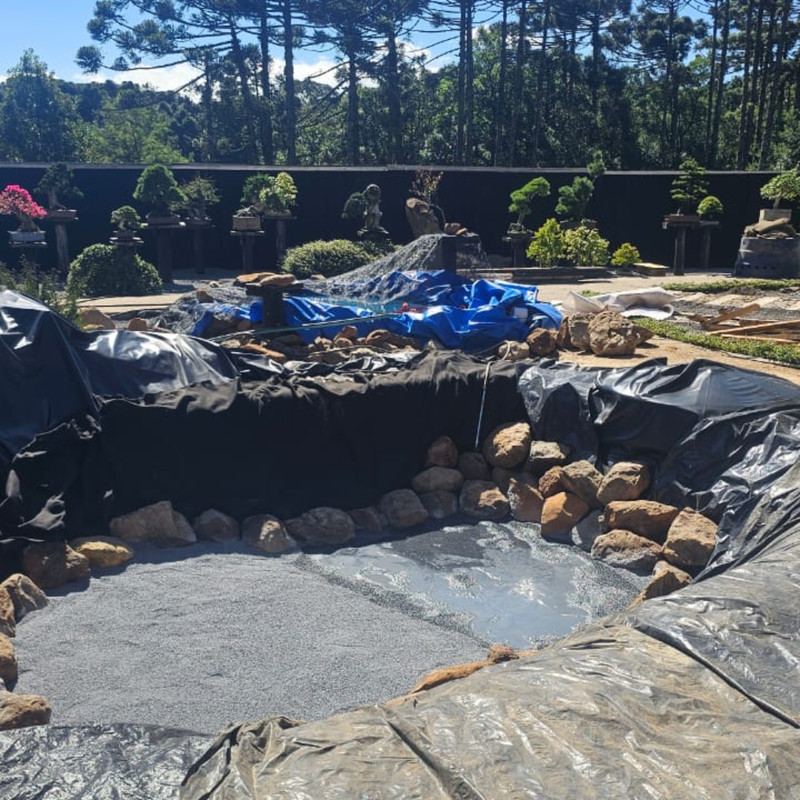
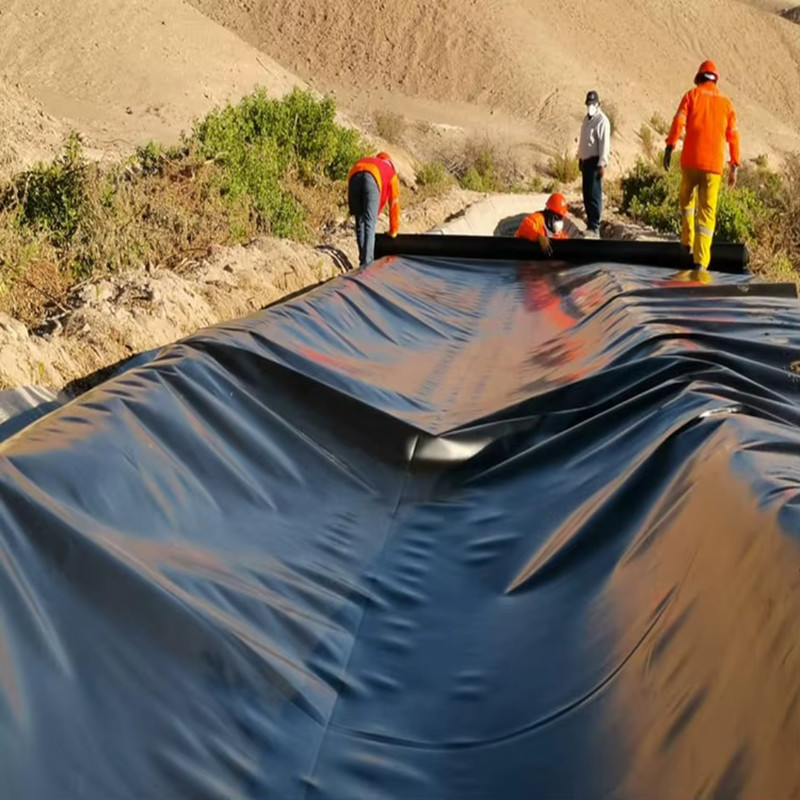
A well-executed installation reduces puncture risk and increases system durability. The process can be carried out in residential projects with attention to details and use of mechanical protection when needed.
- Ground preparation: remove roots, stones and sharp objects; level and compact.
- Geotextile underlayment (recommended): extra puncture protection and smoothing of imperfections.
- Positioning: center the liner and let it relax naturally into the shape.
- Gradual filling: add water slowly, adjusting folds without over-tensioning.
Edge anchoring and time before adding fish
The edge is one of the most important points to prevent leak paths. The most common method is to dig a trench around the pond, fold the liner into it and backfill with compacted soil. Finishing can be done with stones, pebbles and landscaping elements.
- Anchoring: perimeter trench + fold + compaction;
- Finishing: decorative stones, edging and vegetation;
- Before adding fish: wait 24–48 hours (especially with treated water) and stabilize basic parameters.
Maintenance and durability of an ornamental pond with geomembrane
Ornamental pond maintenance is as important as waterproofing. In practical terms, the goal is to reduce debris accumulation and avoid aggressive interventions on the liner.
- Remove leaves and debris regularly (net/strainer);
- Manage algae with proper methods and soft brushes (avoid abrasives);
- Avoid harsh chemicals and solvents;
- Perform a monthly visual inspection of edges and finishing points;
- For minor damage, use kits and procedures compatible with the material.
Good practices extend service life: well-prepared subgrade + mechanical protection (when applicable) + well-anchored edges are the three most relevant factors for long-term durability in the field.
CIKALA technical support
Need help specifying the ideal liner for your pond?
Talk to the CIKALA team and receive guidance on sizing, recommended thickness and installation care for your project.
FAQ – real questions about geomembrane for ornamental ponds
What is a geomembrane for an ornamental pond?
It is a technical waterproof liner applied to the bottom and sides of the pond to prevent leaks, protect the soil and increase the project’s durability.
What is the best geomembrane for a pond with fish?
For ornamental projects, it is recommended to use a liner suitable for continuous water contact and with good long-term stability. CIKALA’s 1000-micron PVC geomembrane stands out for flexibility, resistance and excellent adaptation to curves and details, helping create a stable environment for fish and plants.
What is the ideal geomembrane thickness for an ornamental pond?
In many residential projects, 0.8 mm may work well. For greater robustness and durability, 1.0 mm (1000 microns) is a safe choice, especially for medium and larger ponds with decorative stones and higher mechanical demand.
Is PVC geomembrane safe for fish and plants?
When manufactured for technical applications and used correctly, PVC geomembrane is widely applied in projects with aquatic life, contributing to pond stability and reducing contamination risks associated with improvised materials.
How long does a pond geomembrane last?
Durability depends on the material, thickness, ground preparation and installation. Under well-executed conditions, technical liners can provide long service life, with low maintenance and good stability over the years.
Can the geomembrane be exposed to the sun?
Yes, as long as it is specified with UV protection and applied according to technical recommendations. For outdoor ponds, this is essential to prevent premature aging.
Can I install a geomembrane in an existing pond?
In many cases, yes. It is necessary to evaluate the pond condition, remove inadequate liners, re-level the subgrade and redo edges and finishing. Retrofit projects require special attention to ensure continuous sealing.
Conclusion: a safe, durable choice for your pond
The choice of waterproofing material defines the ornamental pond’s performance over the years. To avoid leaks, rework and frequent maintenance, it is essential to choose a technical solution that matches the project shape and the site’s exposure conditions.
For most landscaping projects, the CIKALA 1000-micron PVC geomembrane delivers an excellent balance of flexibility, mechanical resistance and durability, with more practical installation and superior finishing for organic shapes.
If your goal is to build an ornamental pond with a durable geomembrane that is safe for fish and plants and requires low maintenance, investing in the right specification from the start is the most cost-effective decision in the long run.
Labels: geomembrane, ornamental pond, waterproofing, PVC geomembrane, landscaping, artificial ponds, decorative ponds, ornamental fish, water feature

